
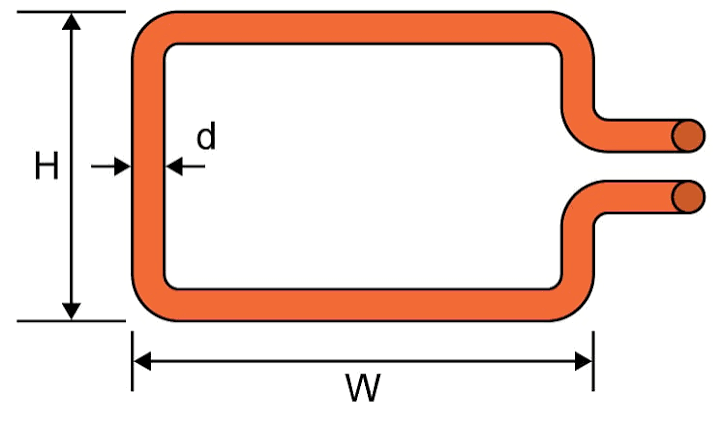
A loop inductor is an important passive electronic component used in circuits that require inductance for controlling current, filtering signals, storing magnetic energy, or reducing electrical interference. Although inductors come in many shapes and designs, loop-style configurations Loop Inductor can provide useful electrical and mechanical characteristics for specific applications. Understanding how a loop inductor works can help engineers, technicians, and electronics enthusiasts select the appropriate component for their circuit requirements.
What Is a Loop Inductor?
A loop inductor is a component designed to create inductance through a conductor arranged in a loop or coil configuration. When electrical current passes through the conductor, it generates a magnetic field around it. The magnetic field stores energy and produces an opposing effect against changes in current.
The amount of inductance depends on several factors, including the number of turns, conductor geometry, core material, physical dimensions, and spacing between turns. A carefully designed loop can therefore provide predictable inductive behavior while fitting into compact electronic assemblies.
Like conventional inductors, loop inductors can be used in both low-frequency and high-frequency applications. Their exact construction varies depending on the intended electrical characteristics and operating environment.
How Does a Loop Inductor Work?
The operating principle of a loop inductor is based on electromagnetic induction. When current flows through a loop of conductive material, a magnetic field develops around the conductor. If the current changes, the magnetic field also changes, creating an induced voltage that opposes the change in current.
This behavior is commonly described by the relationship between voltage, inductance, and the rate of change of current. A higher inductance generally means the component provides greater opposition to rapid changes in current.
In practical circuits, this property makes inductors useful for smoothing current, filtering unwanted signals, managing transient conditions, and storing energy temporarily within a magnetic field.
Key Characteristics of Loop Inductors
Several specifications are important when evaluating a loop inductor. The first is inductance, usually measured in henries or smaller units such as millihenries and microhenries. This value indicates how strongly the component responds to changes in current.
Another important characteristic is current rating. Every inductor has a practical limit for the amount of current it can handle before heating, saturation, or other performance problems occur.
DC resistance is also significant. The resistance of the conductor causes power losses and heat generation when current passes through the component. Lower resistance can be desirable in applications where efficiency is important.
The quality factor, or Q factor, may also matter in high-frequency circuits. It provides an indication of how effectively an inductor stores energy relative to its losses.
Materials Used in Loop Inductor Construction
The construction material has a major influence on the electrical performance of an inductor. Some loop inductors use air as the magnetic medium, while others incorporate magnetic materials to increase inductance within a particular physical size.
Air-core designs can be useful in applications where low losses and predictable high-frequency behavior are important. Magnetic-core designs may achieve higher inductance with fewer turns, making them useful where space is limited.
The conductor itself may be made from copper or another suitable conductive material. Insulation can be added between turns to prevent unwanted electrical contact and maintain reliable operation.
Applications of Loop Inductors
Loop inductors have applications across many areas of electronics and electrical engineering. One common use is signal filtering. Inductors can work with capacitors and resistors to create filters that reduce unwanted frequencies while allowing desired signals to pass.
They can also be used for power supply filtering. In switching power supplies and other power circuits, inductive components help smooth current and reduce electrical noise.
Another application is electromagnetic interference control. Properly designed inductive components can help suppress unwanted high-frequency currents and improve electromagnetic compatibility.
Loop-shaped inductive structures are also found in communication equipment, radio-frequency circuits, sensors, and specialized electronic assemblies. In these applications, physical geometry can influence the component’s electrical response, especially at higher frequencies.
Loop Inductors in High-Frequency Electronics
High-frequency circuits require careful consideration of component geometry. At higher frequencies, factors such as parasitic capacitance, conductor length, spacing, and surrounding materials can affect performance.
A loop inductor may be designed with specific dimensions to achieve the desired electrical response. Engineers must consider not only nominal inductance but also frequency-dependent losses and interactions with nearby components.
Circuit-board traces can themselves form inductive loops. This can sometimes be intentional, but unwanted loops may create electromagnetic interference. Consequently, understanding loop geometry is important both when designing inductors and when laying out high-frequency circuit boards.
Factors to Consider When Selecting a Loop Inductor
Choosing the correct loop inductor begins with identifying the circuit’s electrical requirements. The required inductance should be determined from the circuit design rather than selected based only on physical size.
Operating current is another critical consideration. The component should be capable of handling the expected current without excessive heating or performance degradation.
The operating frequency should also be evaluated. An inductor that performs well at a lower frequency may not behave the same way in a high-frequency application because of parasitic effects and material losses.
Temperature conditions, available installation space, resistance, tolerance, and mechanical requirements can also influence component selection. For demanding applications, manufacturers’ specifications and test data should be reviewed carefully.
Advantages of Loop Inductor Designs
One advantage of a loop configuration is design flexibility. The shape, dimensions, number of turns, and materials can be adjusted to achieve particular inductive characteristics.
Loop structures can also be integrated into compact electronic designs. In some applications, the inductive element may be formed directly into a circuit-board layout, reducing the need for a separate component.
Another benefit is the ability to design the component for particular frequency ranges. With appropriate geometry and materials, loop inductive structures can support specialized filtering, sensing, and signal-processing requirements.
Installation and Circuit Design Considerations
Proper circuit layout is important when working with inductive components. Unnecessary conductor loops can introduce unwanted inductance and electromagnetic coupling. Designers should therefore keep sensitive signal paths controlled and minimize unintended current loops.
When a loop inductor is intentionally used, its position relative to other components should be considered. Nearby conductors, magnetic materials, and high-current paths can affect its behavior.
Thermal management may also be necessary in applications involving significant current. Adequate spacing and appropriate conductor dimensions can help maintain reliable operation.
The Importance of Proper Testing
Testing is an important part of designing or selecting an inductive component. Measurements can verify inductance, resistance, current behavior, and frequency response under actual operating conditions.
For high-frequency applications, testing across the intended frequency range is especially valuable. Laboratory measurements can reveal parasitic effects that may not be obvious from the nominal inductance specification.
Engineers may use impedance analyzers, LCR meters, oscilloscopes, and other suitable instruments to evaluate inductive performance depending on the application.
Future Role of Loop Inductive Technology
As electronic systems continue to become smaller and more efficient, compact inductive structures remain valuable. Modern power electronics, communication systems, sensors, and embedded devices increasingly require components that provide reliable electrical performance within limited physical space.
Advances in materials, manufacturing processes, and circuit integration may allow loop inductors to become more specialized for particular applications. Their ability to be incorporated into circuit structures also makes them relevant to increasingly compact electronic designs.
Conclusion
A loop inductor is a versatile passive component based on the fundamental relationship between electric current and magnetic fields. Its ability to resist changes in current makes it useful for filtering, energy storage, power management, signal processing, and electromagnetic interference control.
Selecting the right loop inductor requires attention to inductance, current capacity, resistance, frequency, physical dimensions, temperature, and circuit layout. When these factors are properly considered, loop inductive designs can contribute to stable, efficient, and reliable electronic systems. As electronics continue to evolve, understanding inductive structures and their practical characteristics will remain an important part of effective circuit design.